
Microsoft for Sustainability, Formerly Cloud for Sustainability: What Changed and What It Means in Australia and New Zealand
Microsoft Cloud for Sustainability is now Microsoft for Sustainability. What was renamed, retired or moved in 2025 and 2026, what replaces each piece, and what it means for AASB S2 and NZ CS reporting.

Microsoft Cloud for Sustainability is now Microsoft for Sustainability. The name changed, several parts of the product set were retired or moved during 2025 and 2026, and Microsoft Sustainability Manager remains at the centre of it. This guide sets out what changed and when, what replaces each retired piece, and what it means for organisations reporting under AASB S2 in Australia and NZ CS in New Zealand. It is written for sustainability leads, CFOs and IT owners who bought on the old name or are evaluating the platform now.
What is Microsoft for Sustainability?
Microsoft for Sustainability is Microsoft's family of products for recording, calculating and reporting environmental, social and governance data. Its core application is Microsoft Sustainability Manager, which takes in activity data such as energy, fuel, travel, purchased goods, water and waste, applies emission factors, and calculates a Scope 1, 2 and 3 greenhouse gas inventory with targets, scorecards and disclosure reporting. Sustainability Manager runs on Dataverse and Power Platform inside your own Microsoft tenant.
Microsoft's documentation now uses the new name throughout. Older proposals, licence schedules and a lot of search results still say "Microsoft Cloud for Sustainability". Both names refer to the same family.
What changed, and when?
| Change | Date | What to use instead |
|---|---|---|
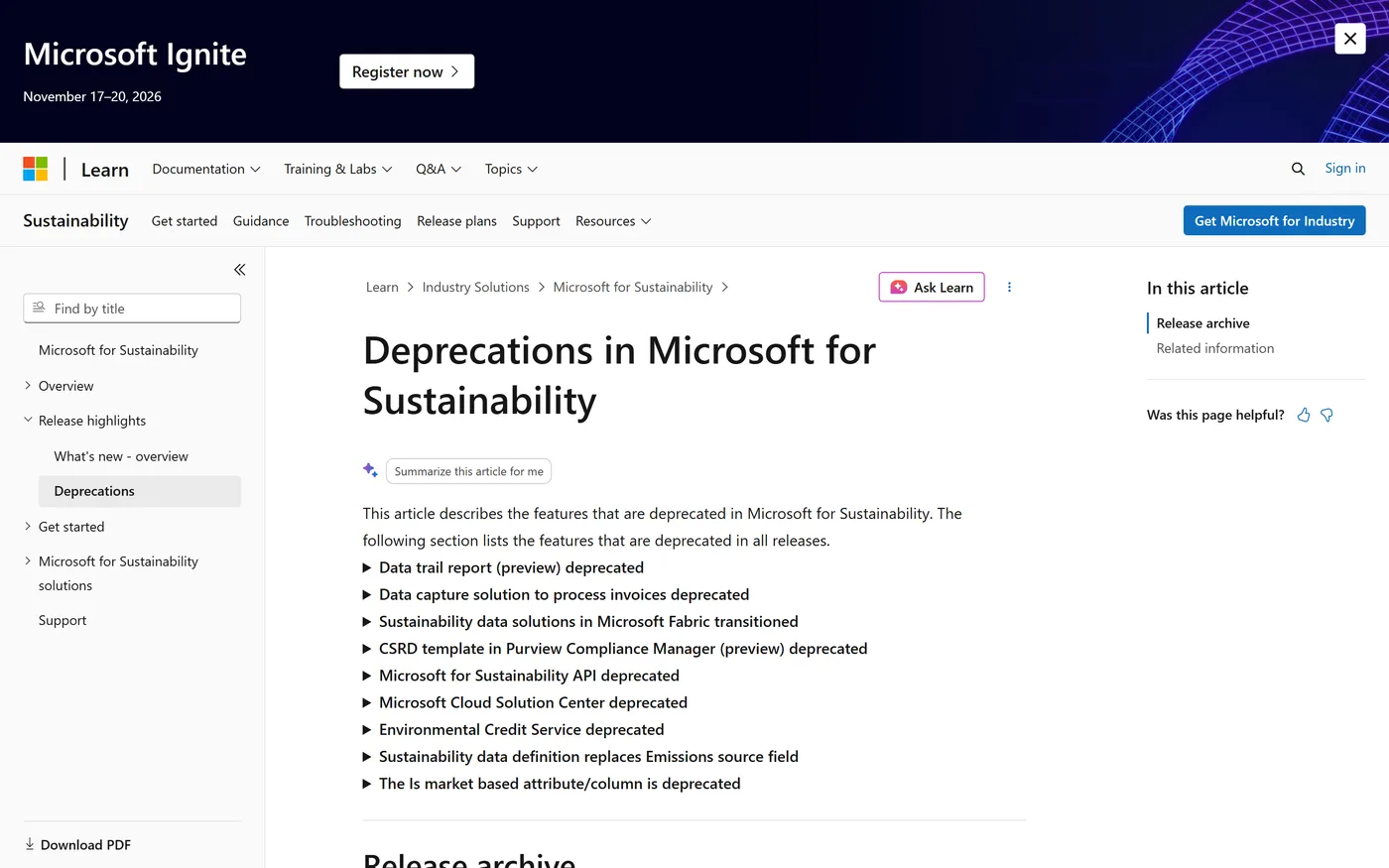
| Microsoft for Sustainability API (preview) deprecated | 30 May 2025 | Azure carbon optimization, for Azure emissions data |
| CSRD template in Purview Compliance Manager (preview) deprecated | 31 October 2025 | External reporting in Sustainability Manager |
| Sustainability data solutions in Microsoft Fabric moved to a GitHub repository | 14 November 2025 | Existing deployments keep working; access to the repository is requested from Microsoft |
| Built-in data capture for invoices in Sustainability Manager deprecated | 5 January 2026 | An OCR flow built with AI Builder, Power Automate and Copilot Studio, or the built-in Arcadia connector |
| Data trail report (preview) deprecated | Not dated by Microsoft | The calculation data trail report in Sustainability Manager |
| Microsoft Cloud Solution Center deprecated | Not dated by Microsoft | Solution deployments go through the Power Platform admin center |
Microsoft describes these changes as streamlining the set around its existing platforms. None of them retires Sustainability Manager itself.
Is Sustainability Manager still supported?
Yes. Sustainability Manager is actively developed and has its own 2026 release waves. It has also grown. The old "emissions source" field has been replaced by a sustainability data definition, so the same ingestion and calculation model now covers water and waste as well as emissions. The replacement data trail report works at calculation level and exports to CSV, which is the evidence an assurer asks for.
The 2025–26 changes mostly affect two groups. Organisations that relied on the built-in invoice capture need a replacement before their next reporting period closes. Organisations that built on Fabric's sustainability data solutions keep a working deployment, but should confirm their access to the GitHub repository, which is now where Microsoft publishes that solution.
Does it support Australian and New Zealand reporting?
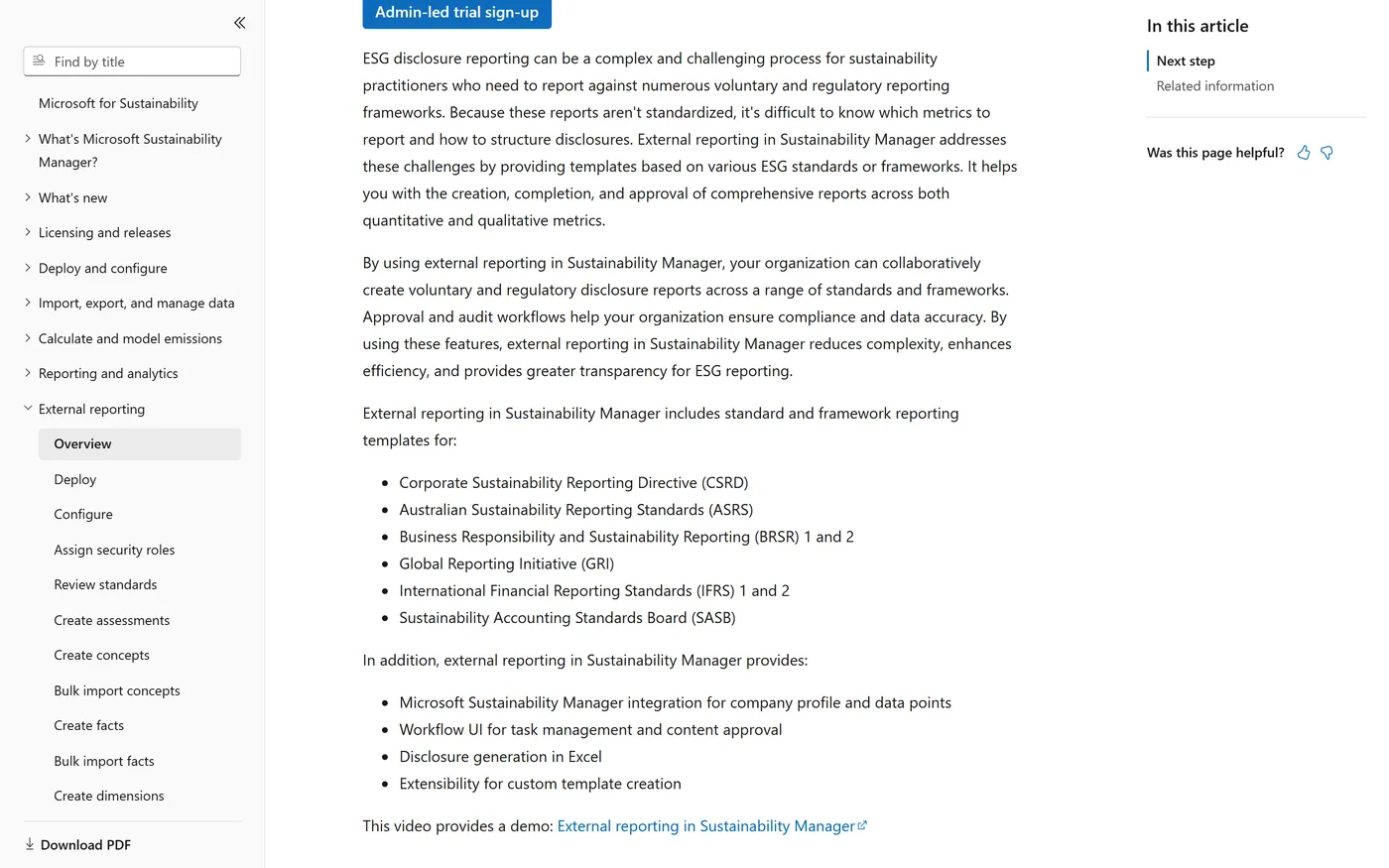
For Australia, largely yes. External reporting in Sustainability Manager includes a template for the Australian Sustainability Reporting Standards (ASRS), alongside CSRD, GRI, IFRS S1 and S2, SASB and BRSR, with approval workflows and disclosure generation in Excel. Australian National Greenhouse Accounts (NGA) emission factors can be used in the platform, versioned by year so the assurer can see which factor applied to each figure.
For New Zealand, there is no NZ CS template in that list. External reporting supports custom templates, so a New Zealand climate statement can be built on the same data points. Many trans-Tasman groups will not need one: since 31 March 2026 an Australian entity that is a New Zealand climate reporting entity can generally rely on its AASB S2 report instead. Our New Zealand climate-related disclosures guide covers who that exemption applies to.
Where does Microsoft Fabric fit now?
Fabric remains the right place for the data engineering around sustainability reporting: landing ERP, utility, fleet and supplier data, reconciling it, and joining emissions to financial data for the AASB S2 metrics. What changed is the packaging. The prebuilt sustainability data solutions that used to sit inside Fabric now come from a GitHub repository rather than as a documented Fabric feature. For most reporters the split is simple: Fabric for the data plumbing, Sustainability Manager for the accounting, the factor libraries and the audit trail.
What should existing customers check?
- If invoices, utility bills or fuel statements reach Sustainability Manager through the built-in data capture, replace it with an AI Builder and Power Automate flow or the Arcadia connector before the next reporting period closes.
- If you deployed Sustainability data solutions in Fabric, confirm access to Microsoft's GitHub repository and record which version you run.
- If you used the preview data trail report as audit evidence, move to the calculation data trail report and re-run it for the current year.
- If you report under AASB S2, compare your disclosure workbook with the ASRS template in External reporting before building anything custom.
- Update procurement records, licence schedules and internal documents that still use the old product name, so renewals and audits refer to the same thing.
If you are starting from scratch, the Microsoft Sustainability Manager page covers what an implementation involves, and the ASRS Readiness Assessment tells you what to build first.
Frequently asked questions
Is Microsoft Cloud for Sustainability the same as Microsoft for Sustainability?
Yes. Microsoft for Sustainability is the current name for the product family Microsoft previously called Microsoft Cloud for Sustainability. Microsoft Sustainability Manager remains its core application.
Is Microsoft Sustainability Manager being retired?
No. Several features around it were deprecated or moved in 2025 and 2026, including the built-in invoice data capture and the preview data trail report, but Sustainability Manager itself continues to be developed and now covers water and waste as well as emissions.
What replaces invoice data capture in Sustainability Manager?
Microsoft deprecated the built-in invoice data capture from 5 January 2026. Its recommended alternatives are an OCR solution built with AI Builder, Power Automate and Copilot Studio, or the built-in Arcadia connector.
Does Sustainability Manager have an ASRS reporting template?
Yes. External reporting in Sustainability Manager includes templates for the Australian Sustainability Reporting Standards, CSRD, GRI, IFRS S1 and S2, SASB and BRSR. It has no NZ CS template, but it supports custom templates.
What happened to Sustainability data solutions in Microsoft Fabric?
Microsoft moved them to a GitHub repository on 14 November 2025. Existing deployments keep working without disruption, and access to the repository is requested from Microsoft.
This guide reflects Microsoft's published documentation as at September 2026, including What's deprecated in Microsoft for Sustainability and the external reporting overview. Check Microsoft Learn for the current state of each feature.
Related resources
Local government software: a buyer’s guide for Australian councils
How to decide between replacing a council’s core system and integrating with it. Includes a comparison of the two options, a cost calculator and questions to ask a supplier.
AI automation for business and government
Most AI projects describe a tool. This describes what happens to the work itself: which tasks move to a system, which stay with a person, and the new work nobody budgets for.
What Is a Forward Deployed Engineer, and Why Is Every AI Company Hiring One?
The title came from Palantir and is now on job boards at every AI company. What a forward deployed engineer actually does, why AI work made the model mainstream, and the six questions to ask a provider.
Got a project in mind?
Book a free 30-minute consultation. We'll listen and give you a straight answer.
Book a Consultation